When most people think of dog training, they picture obedience commands like sit, stay, down, and heel. While these skills can be useful, they do not always prepare dogs for the realities of everyday life. Distractions, emotions, and unpredictable challenges can make learned behaviors fall apart. That is where games-based, concept training comes in.
This approach reflects principles from animal learning science and cognitive psychology. Research shows that play and reinforcement-rich interactions help animals develop flexibility, problem-solving abilities, and resilience alongside adaptive responses to real-world situations.
Moving Beyond Commands
Games-based training builds concepts, which are the life skills that underpin adaptive behavior. Just as children learn resilience, patience, and problem-solving through play, dogs can develop the same skills through structured training games.
These are intentional learning experiences. From a behavioral science perspective, play engages motivation systems and reinforces learning by pairing desirable actions with rewarding outcomes. This increases the likelihood that those actions will be repeated in new and varied situations.
What Are “Concepts”?
Concepts are the building blocks of behavior. They give dogs internal logic to navigate real-world challenges rather than waiting for an external command.
Some of the most useful concepts include:
- Calmness: the ability to regulate arousal and remain relaxed in stimulating environments
- Focus: choosing connection over distraction
- Confidence: handling new situations without fear
- Flexibility: adapting when routines or environments change
- Impulse control: resisting the urge to chase, bark, or jump
When dogs develop these concepts, they naturally make better decisions in daily life without needing constant micromanagement.
Why Use Games?
Games are powerful because they:
- Motivate: Animals are biologically wired to play. Play increases engagement and emotional investment.
- Reinforce naturally: Success within the game becomes rewarding in itself, creating a positive feedback loop.
- Build relationships: Play strengthens trust and connection between dog and handler.
- Create lasting change: What dogs practice repeatedly becomes internalized over time.
Scientific research supports this approach. Animals trained in play-rich environments show greater behavioral flexibility, faster learning, and stronger performance under stress than those trained in rigid, command-only environments.
An Example: Building Calmness
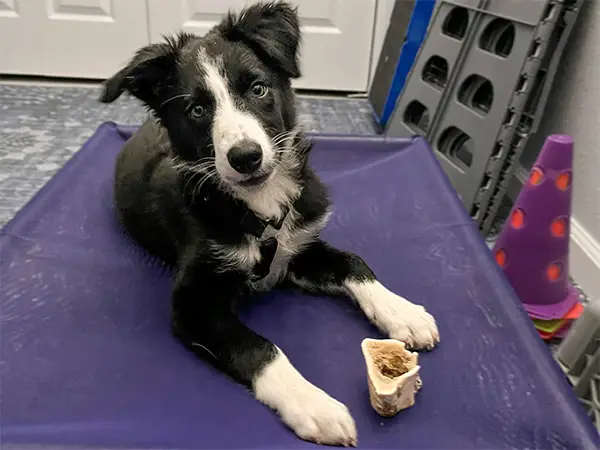
Take a simple “settle” game. A dog is rewarded for lying down on a mat while you move around. At first, it is simply a game. Over time, it builds the concept of calmness in the presence of mild distractions.
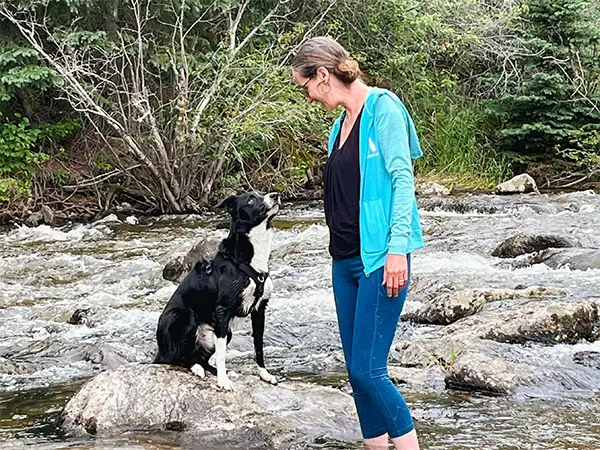
Later, we grow that same calmness to appear when guests come over or when you are sitting outside at a café.
From a learning-science perspective, this works because calm behavior is repeatedly paired with positive outcomes. Calmness becomes valuable to the dog, built into how they experience the world rather than labeled by a command.
Everyday Benefits
With games-based, concept training, you are equipping your dog with life skills. The result is a dog who:
- Walks calmly on leash even when another dog passes
- Comes when called, even with squirrels nearby
- Settles quietly when you are busy rather than demanding attention
A New Way to See Training
Games-based, concept training is a shift in perspective. Rather than asking, “How do I stop my dog from doing this?” you begin asking, “What underlying skill does my dog need more of?” Then you choose a game that builds that skill.
Training becomes connection, growth, and preparation for real-world success.